How domain names are valued comes down to a scoring model, not a guess: appraisers weigh length, extension, keyword relevance, brandability, traceable sales comps, search history, existing traffic, trademark exposure, and category demand together. No single factor decides the price; the combination does. A five-letter .com with a clean trademark record will consistently outprice a longer domain with a flashier niche but a messy legal history. If you have ever wondered why one four-letter domain sells for six figures while a similar-looking one barely clears four, the answer lives in this scoring model – and once you understand it, you can apply it to any domain in minutes.
At LRDEN’s curated marketplace of six-letter domain names for sale, every listing is priced using this same appraisal framework, so buyers aren’t relying on gut feeling when they check out. Understanding the mechanics behind domain valuation protects you whether you’re buying your first brandable name or offloading a portfolio you’ve held for years.
What Determines a Domain Name’s Value?
A domain name’s value is determined by how easily it can be branded, how much organic search demand it already captures, and how defensible it is from a legal standpoint. Professional appraisers don’t rely on instinct alone; they cross-reference historical sales data, traffic tools, and market trends to arrive at a number that a buyer will actually pay.
Because domain valuation isn’t governed by a single central registry of “official” prices, the market runs on comparables, much like real estate. That’s precisely why understanding how domain names are valued gives you an edge whether you’re negotiating a purchase or setting an asking price, and it’s also why relying on a single tool or a single opinion tends to leave money on the table for one side of the transaction.
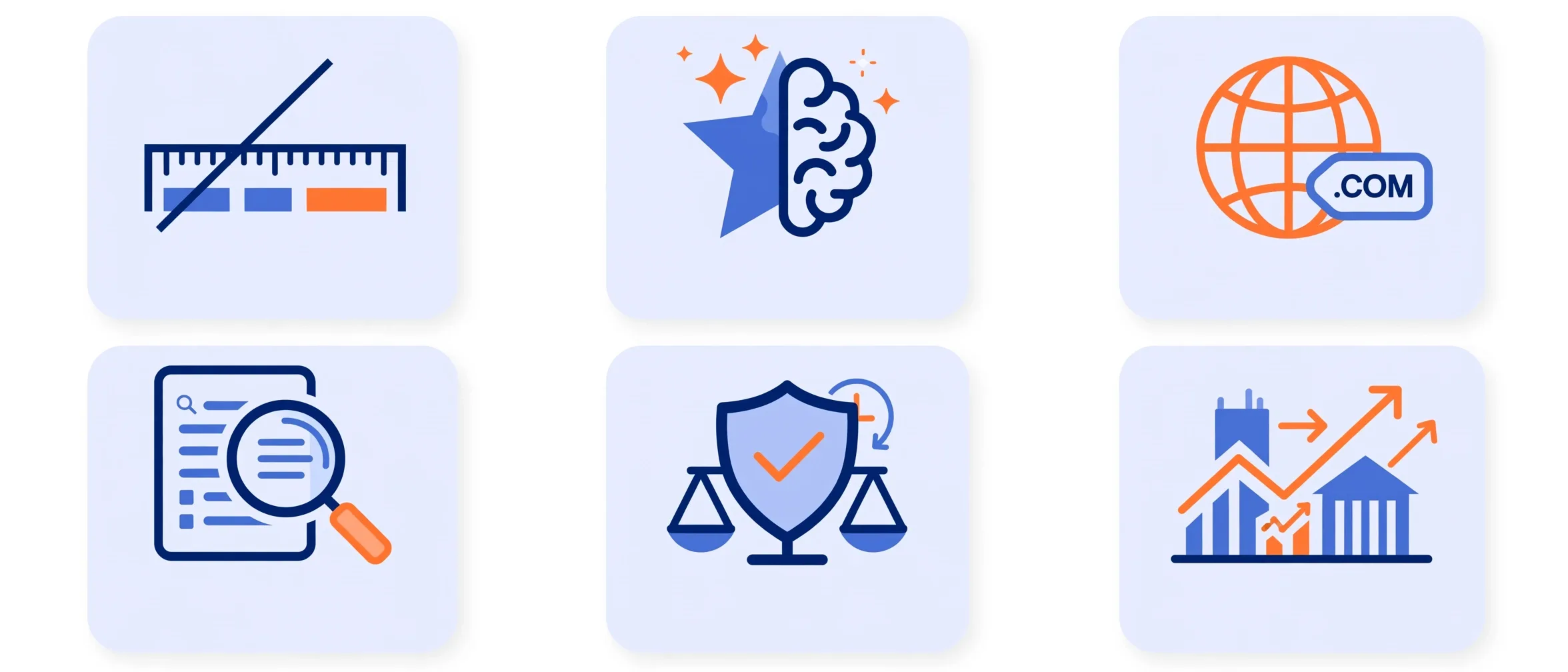
Unlike a house, a domain has no square footage, no comparable zip code, and no bank appraiser walking through it with a clipboard. Instead, its worth is a composite judgment built from measurable signals, some technical, some purely psychological. A buyer who only checks one or two of these signals, such as length or search volume, routinely overpays or underpays because the remaining factors are invisible until someone specifically looks for them.
This is also why prices for seemingly similar domains can vary wildly. Two five-letter .com domains might look identical on the surface, yet one carries a decade of clean SEO history and zero trademark conflicts while the other was previously flagged for spam and shares a name with an active registered brand. Appraisers exist precisely to catch that difference before money changes hands.
Quick Summary: The 9 Valuation Factors
- Length and letter count – shorter is almost always worth more
- Brandability and memorability – can it be said once and remembered?
- Extension (TLD) – .com still commands the widest buyer pool
- Keyword relevance and search intent – does it match what people actually type?
- Domain age and history – registration date and past usage
- Comparable sales data – what similar domains have actually sold for
- Existing traffic and backlink profile – inherited SEO equity
- Trademark and legal cleanliness – does ownership carry legal risk?
- Market category and demand trends – is the niche growing or shrinking?
1. Length and Letter Count
Shorter domains are rarer, and rarity drives price. There are only 308,915,776 possible five-letter combinations using the 26-letter alphabet, and the vast majority of those were registered years ago. Once a length category is largely exhausted, every remaining unregistered or resale-available name in that bracket becomes structurally scarce.
Consequently, appraisers apply a sliding scale:
| Letter Count | Typical Market Perception | Relative Value Tier |
|---|---|---|
| 1-3 letters | Extremely rare, often six to seven figures | Ultra-premium |
| 4 letters | Scarce, strong acronym/brand potential | Premium |
| 5-6 letters | Balanced scarcity and pronounceability | High-value brandable |
| 7-10 letters | Common range, value depends on other factors | Mid-range |
| 11+ letters | Usually low unless keyword-rich | Standard |
This is exactly why domain name length plays such a decisive role in brand success: shorter names are easier to type on mobile, easier to say aloud, and easier to recall after a single exposure.
Length also interacts directly with typo traffic. Every additional character introduces another opportunity for a visitor to fat-finger a key on a phone keyboard, and every mistyped keystroke either sends traffic to a competitor or, worse, to a squatter sitting on a common misspelling. Shorter domains simply have fewer failure points, and appraisers factor that reduced friction directly into their pricing models.
Why Six-Letter Domains Sit in a Sweet Spot
Six-letter domains balance two competing needs: enough scarcity to feel premium, and enough length to form a real word or a clean, pronounceable coinage. That’s the exact inventory tier LRDEN specializes in, since it consistently performs well for startups building a brand from a blank slate.
Furthermore, six letters is often the shortest length at which a genuinely pronounceable, non-acronym English or invented word can still be formed without resorting to awkward vowel-consonant clusters. Four and five-letter combinations frequently force a choice between a real short word (already registered) or an unpronounceable string, whereas six letters opens up meaningfully more usable options while still sitting well inside the “short domain” bracket that buyers actively search for.
2. Brandability and Memorability
Brandability measures how well a domain functions as a standalone identity rather than a literal description. A name like “Zapier” or “Stripe” carries no dictionary meaning tied to invoicing or payments, yet both became household names in their categories because the words themselves were short, punchy, and easy to spell after hearing them once.

The Five-Second Test Appraisers Use
Professional appraisers often apply a simple test: read the domain aloud once, then ask someone unfamiliar with it to spell it back. Domains that pass this test consistently outperform longer, more literal names in resale value, because:
- They reduce typo-related traffic loss
- They transfer cleanly across markets and languages
- They avoid awkward hyphenation or numeral substitutes
- They photograph well on packaging, signage, and app icons
Names that require spelling out (“is that with two Ns or one?”) lose points immediately, regardless of how clever the wordplay seems on paper.
Coined Words Versus Dictionary Words
Appraisers also distinguish between dictionary words and coined, invented words when judging brandability. Dictionary words carry instant meaning but often come with baggage; a generic word domain can feel like a directory site rather than a distinct company. Coined words start as a blank slate, which is a double-edged sword: they carry zero built-in search demand, but they also carry zero risk of feeling generic or interchangeable with a competitor.
In practice, the strongest brandable domains tend to sit at the intersection of both worlds: a word that sounds like it could be real, borrows familiar phonetic patterns from the target language, yet isn’t already burdened with an unrelated dictionary meaning.
3. Extension (TLD) and Why .com Still Wins
The extension, or top-level domain, remains one of the most heavily weighted factors in any credible appraisal. Despite the explosion of alternatives like .io, .co, .ai, and .xyz, .com still captures the overwhelming majority of consumer trust and direct-navigation traffic.
According to Verisign’s quarterly Domain Name Industry Brief, .com consistently remains the largest TLD by registration volume worldwide, which is a strong proxy for buyer familiarity and perceived legitimacy.
How Extensions Rank in Resale Markets
| Extension | Typical Buyer Perception | Resale Liquidity |
|---|---|---|
| .com | Default, universally trusted | Highest |
| .co | Modern, tech-friendly substitute | High |
| .io | Popular with software/startups | Moderate-high |
| .net / .org | Acceptable for non-commercial or infra brands | Moderate |
| New gTLDs (.xyz, .site, etc.) | Niche-dependent, lower average trust | Lower |
Even a well-branded name loses resale value when paired with a low-trust extension, so appraisers always weigh the TLD before pricing the letters.
When a Non-.com Extension Still Makes Sense
That said, extension preference isn’t absolute across every industry. Developer-focused products have embraced .io despite its original ties to the British Indian Ocean Territory, and short, punchy .co domains have found a home among startups that couldn’t secure the matching .com. The deciding question an appraiser asks is whether the target audience for that specific brand already trusts and expects that extension, rather than assuming every buyer wants .com regardless of context.
4. Keyword Relevance and Search Intent
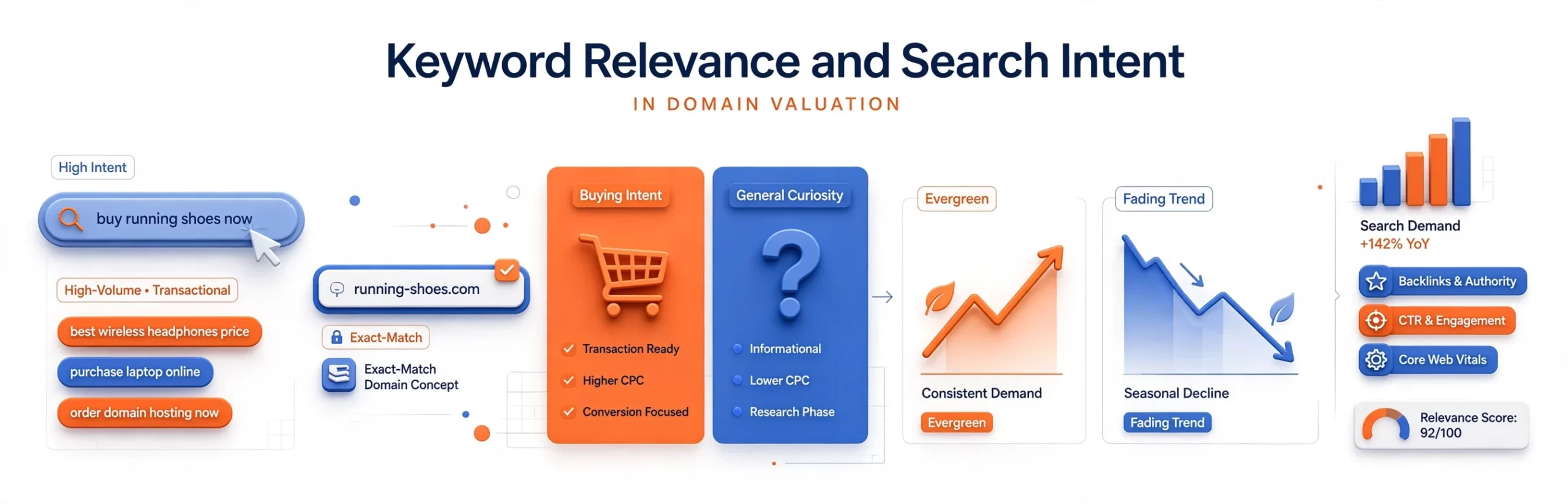
A domain that matches a high-volume, high-intent search term inherits some of that demand automatically. This is especially true for transactional queries where users type the exact phrase into the address bar out of habit, expecting a relevant business to appear.
How Appraisers Score Keyword Relevance
Rather than simply counting search volume, experienced appraisers ask three questions:
- Does the keyword indicate buying intent, or just general curiosity?
- Is the keyword evergreen, or tied to a fading trend?
- Would the exact-match domain realistically outrank a well-optimized subpage on a competitor’s site?
A domain matching “used car finance” carries more resale weight than one matching a passing meme phrase, even if the meme briefly generates a higher search spike, because search interest for financial services persists over time.
Exact-Match Domains in a Post-EMD Search Landscape
It’s worth noting that exact-match domains no longer receive the automatic ranking boost they once did in earlier decades of search. Modern ranking systems reward the overall quality and helpfulness of the content on the site far more than the literal string in the URL. That doesn’t make keyword relevance irrelevant to valuation, though; it simply shifts the reason it matters, from a direct ranking shortcut to a user-trust and direct-navigation advantage, since people still type obvious keyword phrases into browser address bars out of habit.
5. Domain Age and History
Older domains often carry inherited trust signals, provided their history is clean. Search engines and appraisers alike consider registration date, prior ownership, and whether the domain was previously associated with spam, adult content, or manipulative link schemes.
Checking a Domain’s Past Before Buying
Before finalizing any purchase, buyers should verify history using tools like the Wayback Machine and WHOIS history records. A domain that once hosted a legitimate business and simply expired is a very different asset from one that was previously deindexed for spam.
Appraisers typically look for:
- Consistent, legitimate past use (rather than parked pages for a decade)
- No history of penalty flags or manual actions
- A registration date that predates most competitors in the same niche
Why Some Old Domains Are Actually Worth Less
Age alone isn’t automatically a bonus. A domain registered fifteen years ago but left parked with thin ad content the entire time may carry lower trust signals than a domain registered just two years ago and used consistently for a legitimate, growing business. Appraisers read the full history, not just the registration timestamp, before assigning any age-related premium.
6. Comparable Sales Data
Just as a real estate appraiser pulls recent comps in the same neighborhood, a domain appraiser pulls recent sales of similarly structured names. This is arguably the single most reliable input, because it reflects what buyers have actually paid, not what a seller hopes to receive.
Where Comparable Sales Data Comes From
Public sales records, marketplace transaction histories, and aftermarket reports all feed into this analysis. A five-letter pronounceable .com selling for a specific price last quarter sets a strong anchor point for any similar name entering the market this quarter.
| Comp Example | Structure | Why It’s a Useful Comparable |
|---|---|---|
| Recent five-letter .com sale | Pronounceable, no hyphen | Matches structure and length tier |
| Recent keyword-match sale in same niche | Exact-match phrase | Confirms niche demand ceiling |
| Recent sale with similar brandability score | Coined word, short vowel pattern | Validates brandability premium |
Why Comps Beat Gut Instinct
Sellers frequently anchor their asking price to how much effort or emotional attachment went into acquiring the domain, rather than to what the market will actually bear. Comparable sales data removes that bias entirely by grounding the number in what real buyers, with real budgets, chose to pay for a genuinely similar asset within a recent, relevant timeframe.
7. Existing Traffic and Backlink Profile
A domain that already receives direct type-in traffic or holds a backlink profile from past use carries measurable SEO equity. This is distinct from brand value; it’s a technical asset that can shorten the runway for a new site to rank.
What to Check Before Assigning Value to Traffic
Not all inherited traffic is equally valuable. Appraisers typically separate the signal from the noise by checking:
- Whether traffic sources are geographically and topically relevant
- Whether backlinks come from legitimate, editorially earned placements
- Whether analytics show a natural traffic pattern rather than a bot-driven spike
A domain with thin, irrelevant traffic from low-quality directories is often worth less than a domain with zero traffic but a completely clean slate, since the former may require costly disavow work.
Direct Navigation Traffic as a Hidden Asset
One traffic signal that’s easy to overlook is direct navigation: visitors who type the domain straight into their browser rather than arriving through search or a link. This kind of traffic typically indicates real brand recognition or habitual repeat usage, and it’s one of the few traffic sources that carries value regardless of what a new owner plans to do with the site, since it represents people actively seeking out that exact name.
8. Trademark and Legal Cleanliness
A domain that infringes on an existing registered trademark carries hidden risk that dramatically lowers its practical value, regardless of how attractive the name sounds. Buyers who overlook this step can face costly disputes after the purchase is finalized.
How to Check Trademark Exposure
Before buying or pricing a domain, it’s worth searching the USPTO’s trademark database for exact and phonetic matches in relevant business categories. A clean search result doesn’t guarantee zero risk internationally, but it substantially reduces exposure in the largest single market.
Appraisers typically apply a discount, sometimes a steep one, to any domain that:
- Closely matches an active registered trademark in a related industry
- Has previously been the subject of a UDRP (Uniform Domain-Name Dispute-Resolution Policy) complaint
- Uses a brand name variant likely to invite a cease-and-desist letter
UDRP Risk and Why It Matters to Value
The Uniform Domain-Name Dispute-Resolution Policy, overseen through processes coordinated by the Internet Corporation for Assigned Names and Numbers, gives trademark holders a faster, cheaper path than litigation to reclaim a domain used in bad faith. A buyer who acquires a domain sitting close to an active trademark inherits that dispute risk immediately upon transfer, which is precisely why appraisers apply a discount rather than treating the letters and the legal standing as separate, unrelated variables. For deeper background on how these policies work, the ICANN dispute resolution resources outline the process in full.
9. Market Category and Demand Trends
Finally, the broader category a domain sits in shifts its value up or down independent of the letters themselves. Categories tied to durable, recurring demand (finance, health, real estate, software) tend to hold value better than categories tied to short-lived trends.
Reading Category Momentum
Appraisers track category momentum by watching aftermarket sales volume within a niche over rolling quarters. A steady or growing sales count across a category signals healthy buyer demand, while a sharp drop-off after an initial trend spike is a warning sign for anyone pricing a domain in that space today.
Durable Categories Versus Trend-Driven Categories
Finance, healthcare, real estate, legal services, and core software categories tend to show remarkably stable aftermarket demand year over year, because the underlying businesses they serve aren’t going anywhere. By contrast, domains tied to a single viral product, a short-lived slang term, or a narrow technology fad can spike briefly and then collapse in resale value once buyer attention moves elsewhere.

When valuing a domain in a fast-moving category, it’s worth asking whether the underlying industry itself will still exist in a recognizable form five years from now.
A Worked Example: Comparing Two Similar Domains
To see the framework in action, consider two hypothetical five-letter .com domains offered at the same time. The first is a pronounceable, coined word with no trademark conflicts, a clean WHOIS history stretching back over a decade, and three closely comparable sales in the past year averaging a solid mid five-figure price. The second looks similar at a glance, but a closer check reveals it shares its name with a regional retail chain’s registered trademark and previously redirected to a since-deindexed content farm.
On the surface, both domains would score identically on length and extension alone. Once brandability, history, comparable sales, and trademark cleanliness are factored in, the first domain would reasonably appraise several times higher than the second, illustrating exactly why relying on a single factor in isolation produces an unreliable number.
Tools Appraisers Use Alongside the Nine Factors
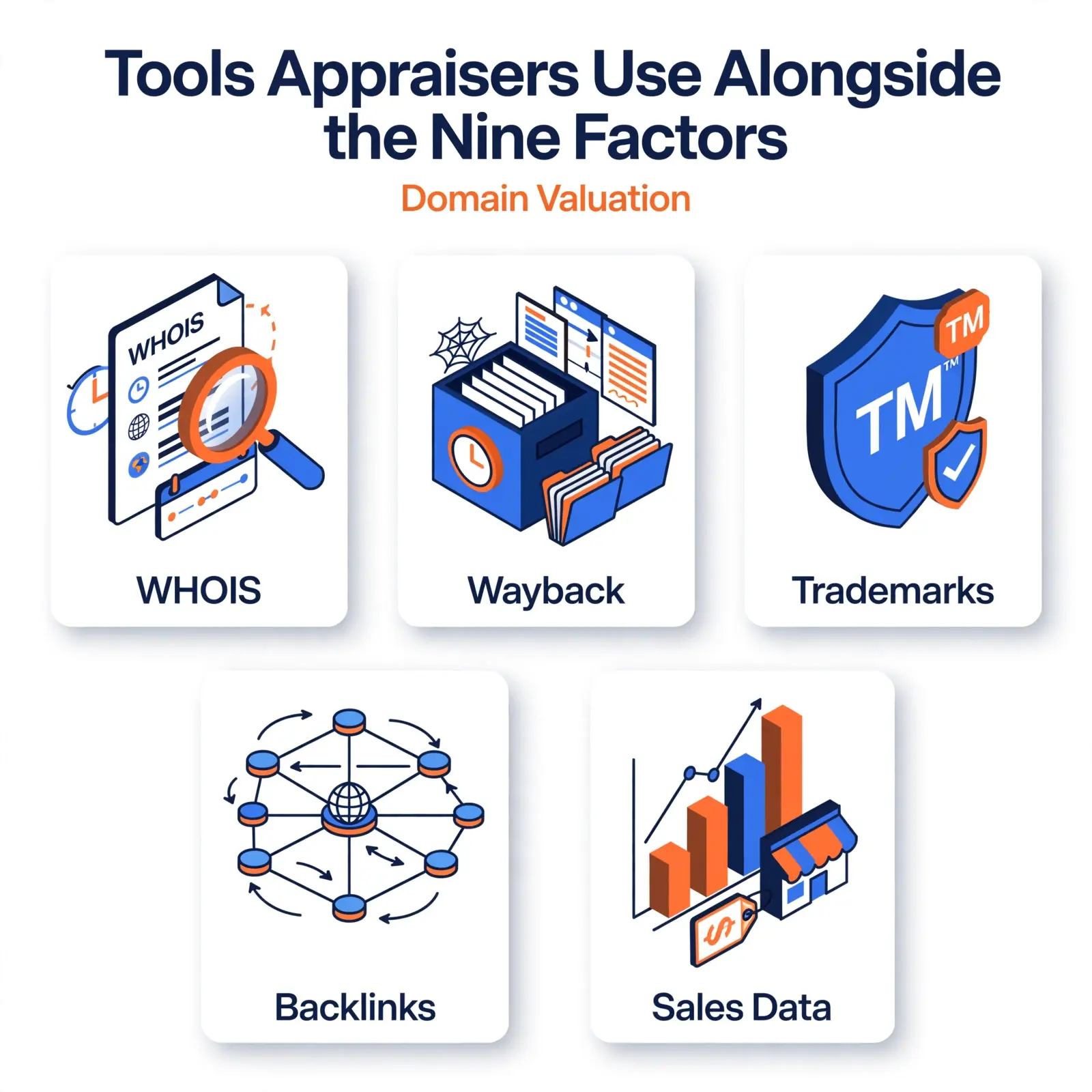
No single tool replaces the judgment behind these nine factors, but a handful of resources make the research faster and more reliable.
- WHOIS history lookups: confirm registration date, past ownership changes, and expiration history.
- The Wayback Machine: reveal how a domain was previously used, and whether that use was legitimate.
- Trademark registries: flag potential legal conflicts before a purchase is finalized.
- Backlink analysis tools: separate genuine, editorially earned links from spammy or purchased ones.
- Marketplace sales archives: supply the comparable sales data that anchors a realistic price.
Used together, these resources let a buyer or seller move from a gut feeling to a documented, defensible number, which matters most when a transaction is large enough to justify the extra diligence.
Common Mistakes Buyers and Sellers Make During Valuation
- Anchoring to acquisition cost: what a seller originally paid has no bearing on current market value, since demand for that name may have shifted significantly in either direction since the original purchase.
- Ignoring the extension discount: assuming a new gTLD will command .com-level pricing, when in reality the same letters on a lesser-trusted extension often sell for a fraction of the price.
- Skipping the trademark check: discovering legal exposure only after the transfer completes, at which point a dispute can force a costly and time-consuming resolution process.
- Overweighting search volume alone: without checking buying intent behind the keyword, which can lead to paying a premium for traffic that never converts into revenue.
- Relying on a single automated appraisal tool instead of cross-checking with recent comparable sales, since automated scores frequently miss brandability and legal nuance entirely.
Expert Tips for a More Accurate Valuation
- Pull at least three recent comparable sales before setting or accepting a price, since a single outlier sale can badly skew perceived market value if treated as the sole reference point.
- Always run a WHOIS history and Wayback Machine check before buying, so any prior misuse of the domain surfaces before money changes hands rather than after.
- Weight brandability and extension above raw keyword match for long-term holds, because a company’s brand identity will outlast any short-term search trend tied to a specific keyword.
- Treat automated appraisal scores as a starting point, not a final number, and always cross-check them against real, recent comparable transactions.
- Factor in your specific use case; a name perfect for a startup brand may be a poor fit for an SEO-driven affiliate site, and vice versa, so define your goal before you start comparing prices.
- Revisit your valuation periodically if you’re holding a domain long-term, since category demand and comparable sales data both shift meaningfully over a multi-year holding period.
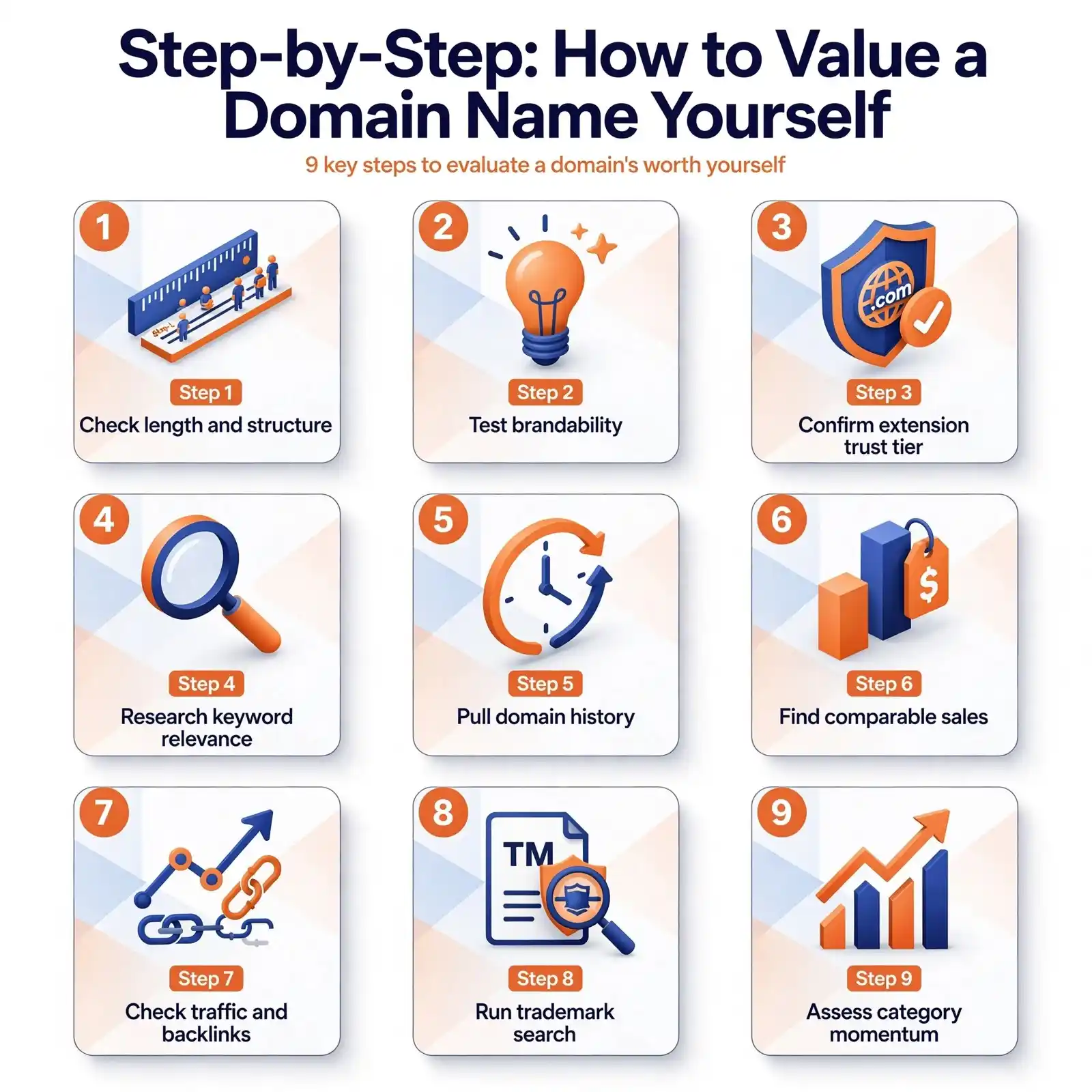
Step-by-Step: How to Value a Domain Name Yourself
- Check length and structure: count letters, note hyphens or numerals.
- Test brandability: say it aloud, ask someone to spell it back.
- Confirm the extension’s trust tier: .com, then .co/.io, then others.
- Research keyword relevance: check search volume and buying intent.
- Pull domain history: WHOIS records and Wayback Machine snapshots.
- Find three to five comparable sales: match on length, structure, and niche.
- Check inherited traffic and backlinks: confirm quality, not just quantity.
- Run a trademark search: USPTO and equivalent registries for your target market.
- Assess category momentum: is demand in this niche rising or falling?
Looking for more guidance before you buy? read our full guide on buying a premium domain name without overpaying for a practical negotiation checklist.
How Domain Names Are Valued: A Comparison of Valuation Approaches
| Valuation Method | Best For | Limitation |
|---|---|---|
| Automated appraisal tools | Quick, rough estimates | Doesn’t account for brandability or legal risk |
| Comparable sales analysis | Setting a realistic asking price | Requires access to reliable sales records |
| Professional human appraisal | High-value or contested domains | Costs a fee and takes longer |
| Marketplace curation (e.g., LRDEN) | Buyers wanting pre-vetted inventory | Selection limited to curated list |
Frequently Asked Questions
How do professionals determine how domain names are valued?
Professionals determine how domain names are valued by combining data on length, brandability, extension, keyword relevance, domain history, comparable sales, inherited traffic, trademark exposure, and category demand into a single composite score.
What is the single most important factor in domain valuation?
No single factor dominates, but comparable sales data is often considered the most reliable input, since it reflects actual buyer behavior rather than theoretical potential.
Does a .com domain always sell for more than other extensions?
Not always, but .com carries the strongest default trust and liquidity, so an identical name typically commands a meaningful premium over the same name on a newer extension.
Can a short domain still be worth little?
Yes. A short domain with an unpronounceable letter combination, a damaged history, or trademark conflicts can be worth far less than a slightly longer, cleaner alternative.
How often should comparable sales data be updated when pricing a domain?
Ideally every quarter, since aftermarket sales trends shift as buyer demand moves between categories and as new comparable transactions close.
Do automated domain appraisal tools give an accurate price?
Automated tools are useful for a rough first estimate, but they typically miss brandability nuance, legal risk, and true market comparables, so treat their output as a starting range rather than a final valuation.
Should I hire a professional appraiser for every domain purchase?
For lower-value, common-length domains, self-assessment using the nine factors above is usually sufficient; for high-value or legally ambiguous domains, a professional appraisal or attorney review is a reasonable added expense.
Conclusion
Understanding how domain names are valued turns a subjective guessing game into a repeatable, evidence-based process. Length, brandability, extension, keyword relevance, history, comparable sales, traffic, trademark cleanliness, and category demand all combine to produce a fair market number, and skipping any single factor can lead to an overpriced purchase or an underpriced sale.
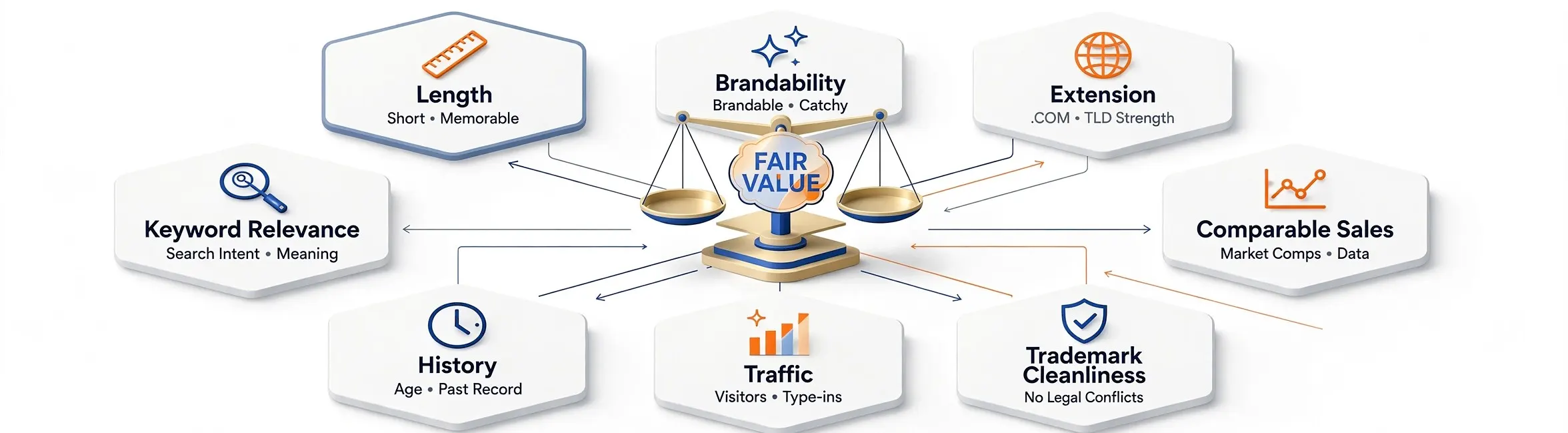
Whether you’re pricing a single name for resale or building an entire portfolio strategy around it, treating these nine factors as a checklist rather than a vague impression will save you from the two most common outcomes in this market: overpaying out of excitement, or underselling out of impatience. The domains that hold value best over time are almost never the ones that scored highest on a single dimension; they’re the ones that held up reasonably well across every factor at once.
If you’re ready to apply this framework to a real purchase,and see how each listing stacks up against these nine factors before you buy.