
Your domain name functions as a pre-verbal brand signal – visitors form credibility judgments about your business within milliseconds of seeing it, long before any headline, product photo, or value proposition loads on screen. This is the essence of the domain name and brand identity connection: the URL itself carries semantic weight, phonetic tone, and trust cues that shape perception before your copywriting gets a chance to persuade anyone. Founders who treat their domain as an afterthought are effectively asking their marketing team to fight an uphill battle against a first impression they never controlled.
Every founder obsesses over logo design, color palettes, and tagline wording. Yet the one asset that appears in every single customer touchpoint – search results, email signatures, business cards, ad URLs, browser tabs – often gets chosen in a rushed five-minute decision. That gap between effort and impact is exactly where competitors gain ground. Before a visitor reads a word of your homepage, they’ve already formed an opinion based on your domain’s structure, length, and clarity. This guide explains why that happens, what the research and industry practice show, and how to choose a domain that reinforces rather than undermines your brand.
If you’re actively comparing options, browsing 6 letter domain names for sale is a practical starting point, since shorter names tend to carry the clean, memorable qualities this article discusses in depth.
What is the Domain Name and Brand Identity Connection?
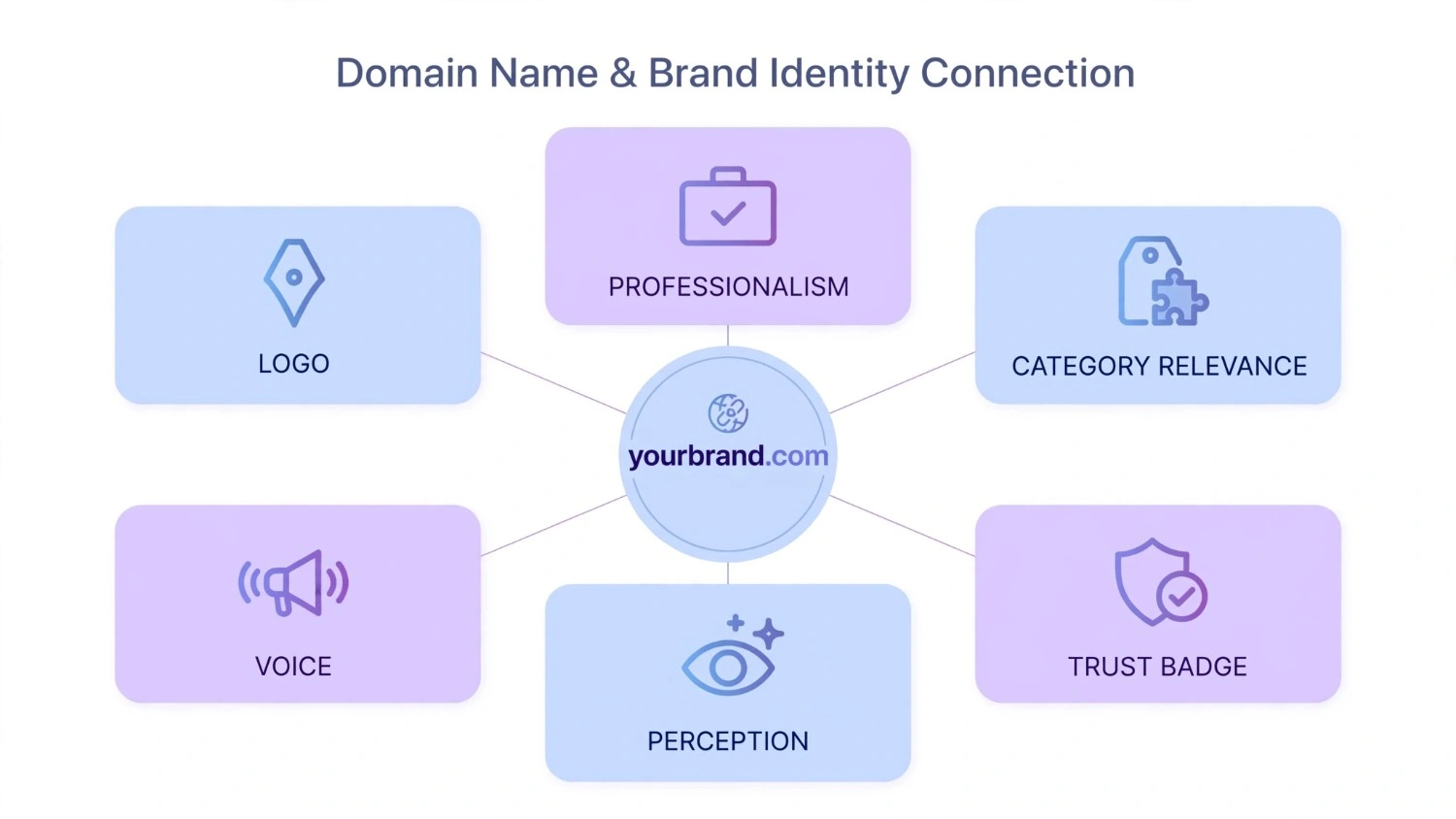
The domain name and brand identity connection refers to the psychological and functional link between a website’s URL and how audiences perceive the trustworthiness, professionalism, and category relevance of the business behind it. In simple terms: your domain isn’t just a technical address, it’s a branding asset that either supports or contradicts everything else you’re trying to communicate.
Marketers sometimes separate “brand” (logo, voice, positioning) from “domain” (technical infrastructure), but consumers don’t experience them separately. A domain is the first piece of brand copy most people encounter, whether it’s printed on a billboard, pasted into a browser, or displayed in a search snippet.
Quick Answer for Search
A strong domain name reinforces brand identity by signaling professionalism, industry relevance, and trustworthiness before the visitor sees any other content, while a weak or confusing domain forces the brand to overcome a credibility deficit from the very first impression.
Why First Impressions Start at the URL, Not the Homepage
Consider the sequence of events when someone discovers a new business:
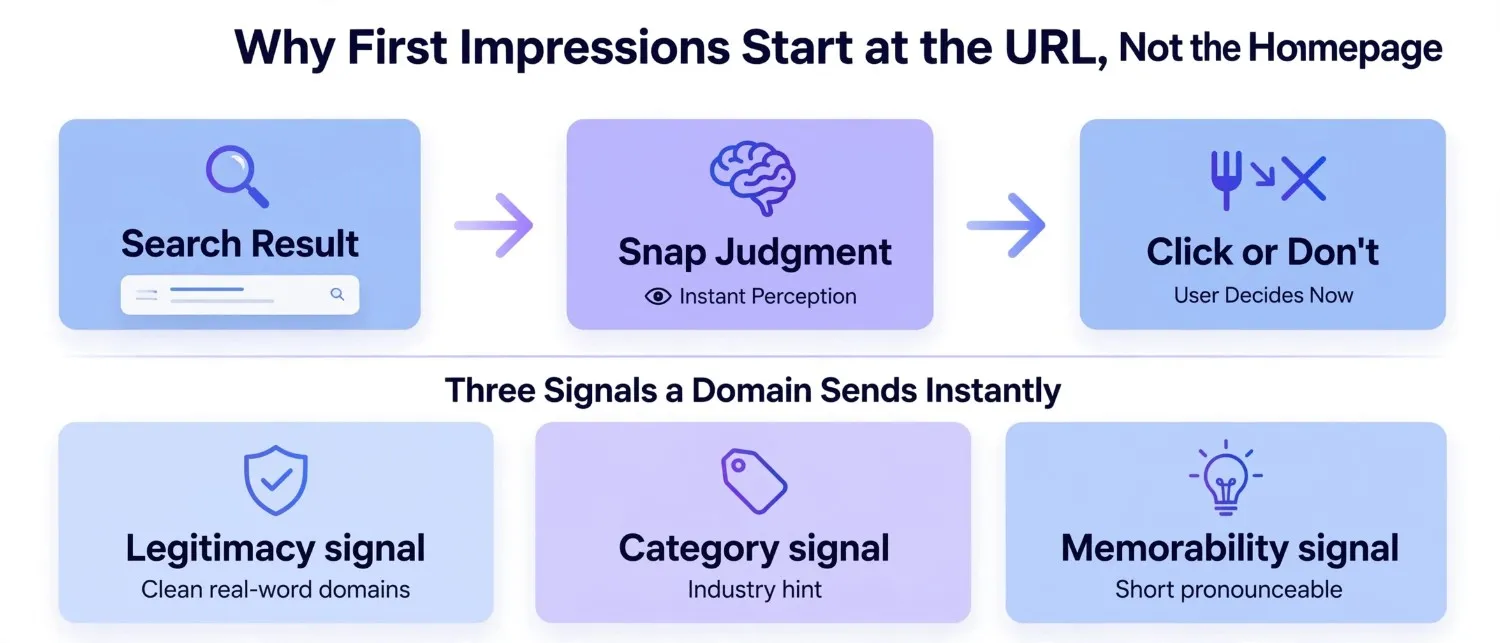
- They see the domain in a search result, ad, or referral.
- They form a snap judgment about legitimacy and category.
- They click – or they don’t.
- Only after clicking do they encounter design, copy, and product details.
Step two is where most businesses lose ground without realizing it. Research on online trust consistently shows that surface-level cues, including URL structure, influence credibility judgments almost instantly. That means your domain is doing brand work whether you designed it to or not.
The Three Signals a Domain Sends Instantly
Legitimacy signal
Clean, real-word domains read as established businesses. Long, hyphenated, or numeral-stuffed domains read as low-budget or spam-adjacent.
Category signal
A domain that hints at the industry (even loosely) helps visitors mentally categorize the business faster, which reduces cognitive friction.
Memorability signal
Short, pronounceable domains are easier to recall, repeat verbally, and type correctly, all of which compound into more direct traffic over time.
How Domain Length Shapes Perceived Professionalism
Consequently, domain length is one of the most measurable factors in the domain name and brand identity connection. Shorter domains are consistently associated with premium, established brands, largely because scarcity and cost push most short, real-word domains into the hands of companies with the budget to acquire them.
For a deeper breakdown of how character count affects branding outcomes specifically, see why domain name length matters for brand success, which walks through the data behind this pattern in more detail.
Comparison: Short vs. Long Domain Names
| Attribute | Short Domain (6–10 characters) | Long Domain (15+ characters) |
|---|---|---|
| Recall after single exposure | High | Low |
| Verbal shareability (“say it out loud”) | Easy | Difficult |
| Typo risk | Low | High |
| Perceived investment/credibility | Higher | Lower |
| Typical acquisition cost | Higher (premium market) | Lower |
| Fit for voice search and word-of-mouth | Strong | Weak |
This isn’t a claim that longer domains never work; descriptive, keyword-rich domains can perform well for SEO-first niche sites. But for brands prioritizing recognition and trust, brevity consistently wins.
The Psychology Behind Domain-Driven Trust
Humans are pattern-matching machines, and the brain processes familiar linguistic structures faster than unfamiliar ones. A domain built from a real word, a clean invented word, or a recognizable phrase gets processed more fluently than a string of disconnected characters or excessive hyphens.
This fluency effect matters more than most founders realize:
- Content that’s easier to process is rated as more trustworthy, even when the underlying information is identical.
- The same bias applies to brand names and domains: fluent, easy-to-read domains are judged more favorably than clunky ones.
- That judgment happens in a fraction of a second, before conscious reasoning kicks in.
In other words, a confusing domain isn’t just a marketing inconvenience, it’s actively working against your brand’s perceived credibility at a neurological level.
Domain Name and Brand Identity Connection in Practice: Real Patterns
Across industries, a few consistent patterns show up when businesses evaluate or rebrand their domains:
Pattern 1: Category Fit Beats Cleverness
A domain that’s too abstract forces visitors to work harder to understand what the business does. Clever wordplay can work for consumer brands with big marketing budgets, but for most growing businesses, a domain with some intuitive category fit performs better in the early trust-building phase.
Pattern 2: Consistency Across Channels Reinforces Recall
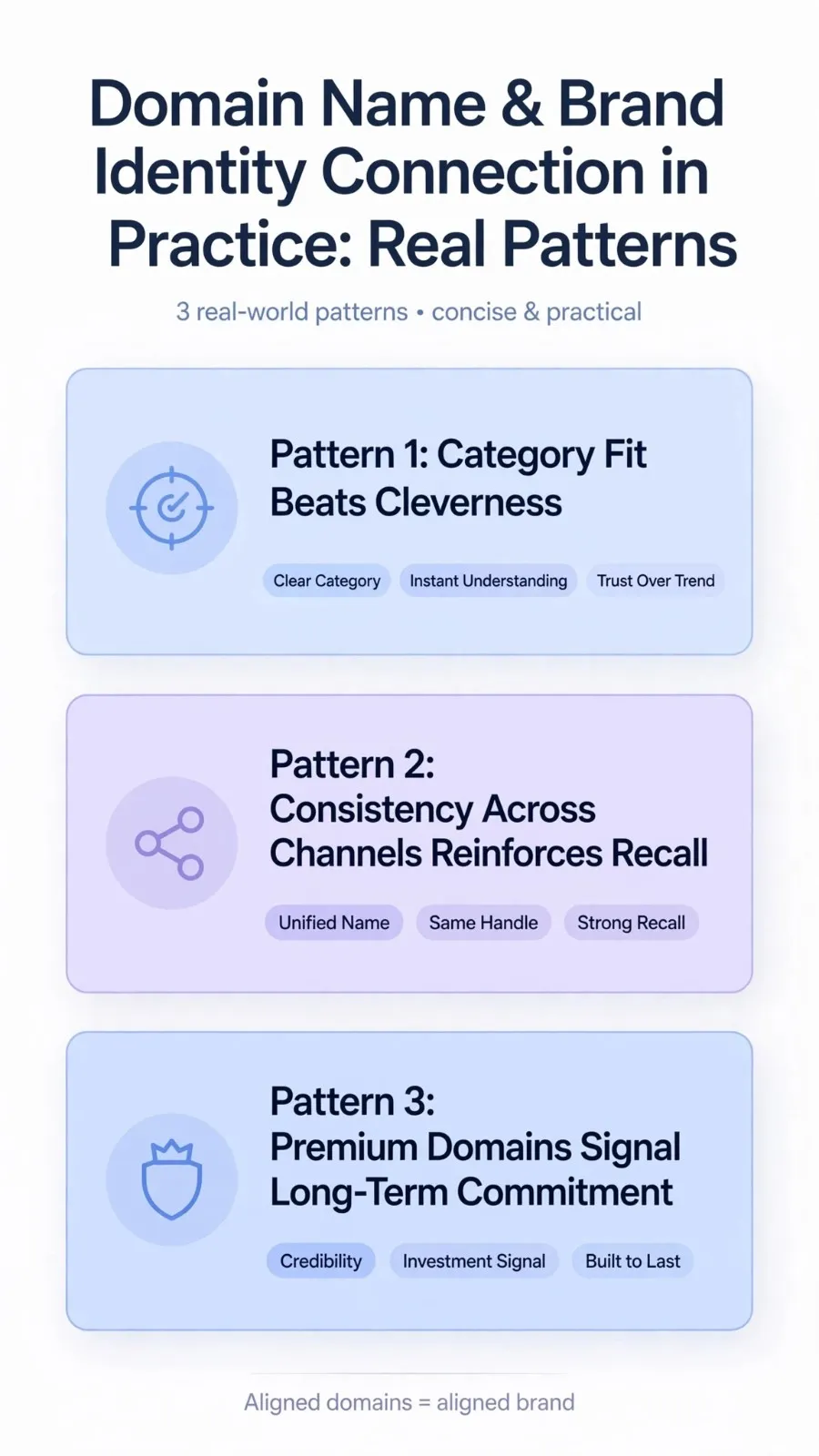
When the domain matches the business name used on social media, packaging, and signage, brand recall compounds across every touchpoint. Mismatched domains (where the URL differs meaningfully from the spoken brand name) create friction that measurably reduces direct traffic.
Pattern 3: Premium Domains Signal Long-Term Commitment
Investors, partners, and enterprise customers often use domain quality as an informal due-diligence signal. A premium, well-matched domain suggests the founders planned for scale rather than treating the website as an afterthought.
Industry-by-Industry: Where the Domain-Brand Link Matters Most
Not every industry feels the domain name and brand identity connection with equal intensity. Trust-sensitive and high-consideration categories tend to see the strongest effects, since buyers in these spaces actively look for reasons to doubt an unfamiliar vendor before committing.
E-Commerce and Retail
Shoppers abandon unfamiliar checkout pages at high rates when trust signals are weak, and the domain is one of the earliest signals they evaluate. A clean, recognizable domain reduces the “is this a scam?” hesitation that otherwise slows down conversion, especially for first-time visitors arriving from paid ads rather than organic search.
B2B and SaaS
Enterprise buyers frequently forward a vendor’s URL internally for procurement review before anyone on the buying committee visits the site. A domain that looks improvised, or that requires explanation (“it’s spelled with a K, not a C”), adds friction to a process that already involves multiple stakeholders and layers of approval.
Professional Services (Legal, Financial, Medical)
In these categories, trust is the entire product. A domain that feels casual, overly clever, or hard to spell undercuts the gravity that clients expect from a lawyer, financial advisor, or healthcare provider. Short, real-word, or clearly professional domains consistently outperform experimental branding choices in these spaces.
Domain Investment and Resale Markets
Interestingly, the domain name and brand identity connection also drives value inside the domain aftermarket itself. Buyers shopping for a domain to build a company around are, in effect, shopping for a pre-built trust signal. That’s precisely why short, clean, brandable names command premium resale prices compared to purely descriptive or lengthy alternatives.
What the Data Suggests About Domains and Conversion Behavior
While no single metric isolates domain quality from every other variable on a page, several observable patterns show up consistently across marketing and UX research:
- Cognitive fluency correlates with trust. Information that’s easier to process, including a domain name, tends to be judged as more truthful and more credible than information that requires extra mental effort to parse.
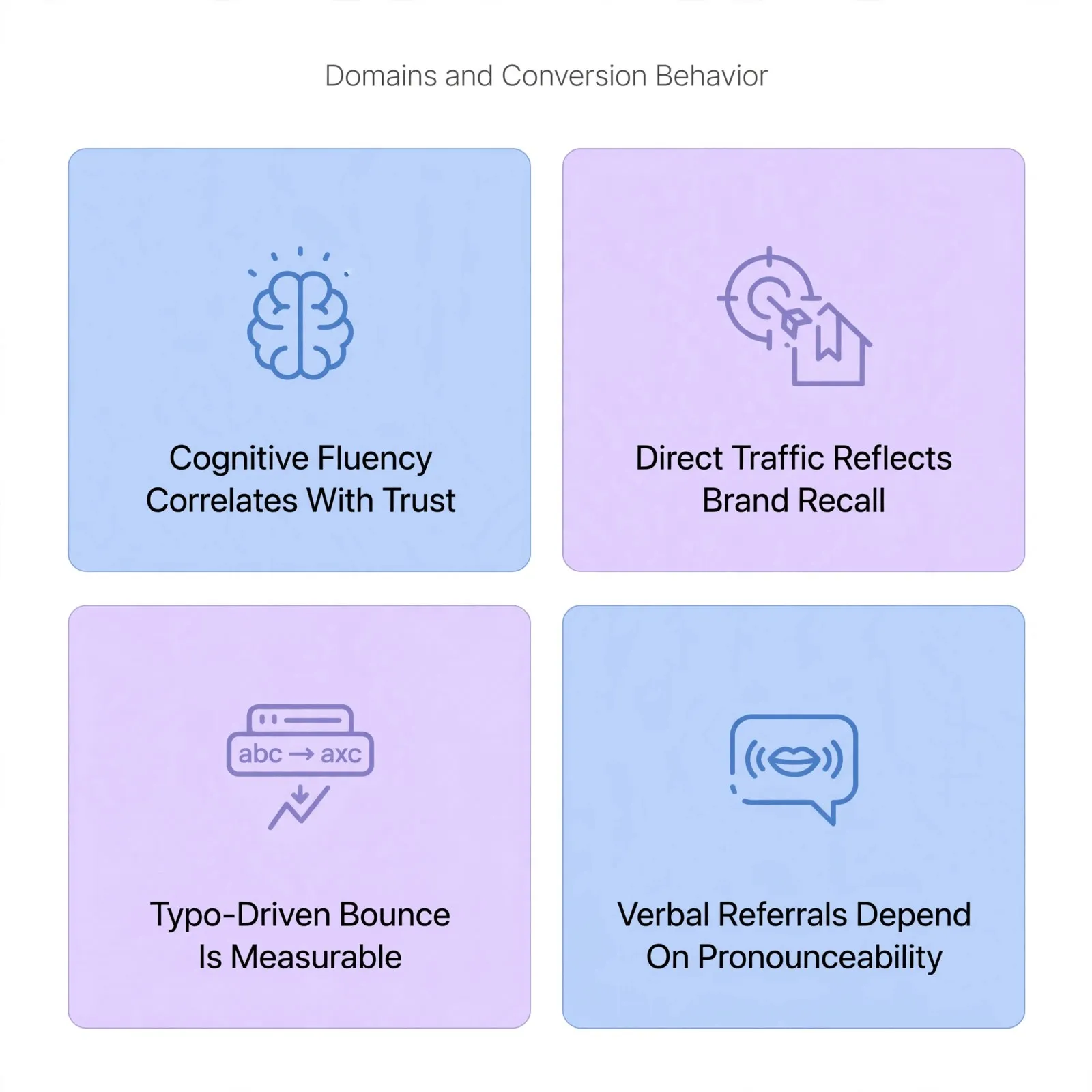
- Direct traffic reflects brand recall. Businesses with strong, memorable domains typically see a higher share of direct (type-in) traffic relative to competitors with harder-to-recall names, since customers can actually remember and retype the URL.
- Typo-driven bounce is measurable. Long or hyphenated domains generate more failed navigation attempts, meaning some percentage of interested customers never reach the site at all because they mistyped the address.
- Verbal referrals depend on pronounceability. Word-of-mouth referrals, still one of the highest-converting acquisition channels for many businesses, break down when a friend can’t accurately repeat a domain name out loud.
None of these factors operate in isolation, but together they explain why domain quality shows up repeatedly as a quiet multiplier across a brand’s other marketing investments.
Domain Name Archetypes and the Brand Signals They Send
Not all short, clean domains send identical signals. It helps to think in terms of archetypes when evaluating options:
- Real-word domains (a dictionary word used as the brand name): Signal familiarity and instant category understanding, but often carry a higher acquisition price since availability is scarce.
- Invented or coined domains (a constructed word that sounds real): Signal originality and are often trademark-friendly, though they require more initial brand-building to establish meaning.
- Compound domains (two real words combined): Balance clarity and availability, though they risk feeling generic if overused within a category.
- Abbreviated or acronym domains: Work well once a brand is established, but demand more upfront marketing investment since they carry no inherent meaning to new visitors.
Matching the archetype to your business stage, budget for brand-building, and industry expectations is often more important than chasing the shortest possible character count.
Common Mistakes That Break the Domain-Brand Link
Even experienced founders make avoidable errors when selecting a domain. Here are the mistakes that most frequently undercut brand identity:
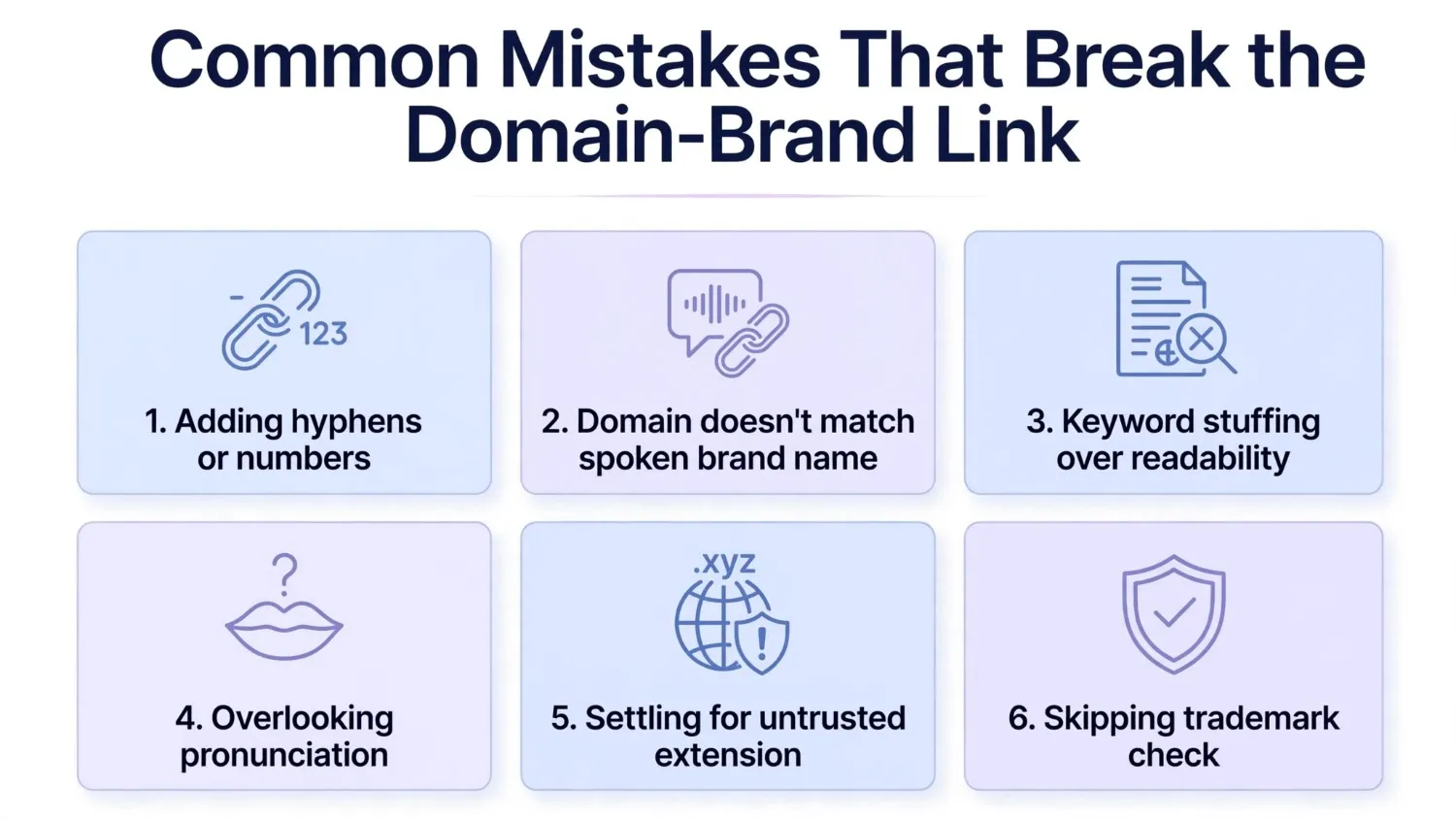
- Adding unnecessary hyphens or numbers to secure availability, which increases typo risk and looks improvised.
- Choosing a domain that doesn’t match the spoken brand name, forcing customers to remember two different things.
- Prioritizing keyword stuffing over readability, which may have helped a decade ago but now reads as dated and spam-like.
- Overlooking pronunciation, since a domain that’s hard to say out loud limits word-of-mouth referrals.
- Settling for an extension that undermines trust, particularly obscure or unfamiliar top-level domains in trust-sensitive industries like finance or healthcare.
- Skipping a trademark and brand-conflict check, which can create legal headaches long after launch.
Avoiding these pitfalls up front is far cheaper than rebranding after the domain has already been printed on marketing materials, business cards, and legal documents.
Expert Tips for Choosing a Domain That Strengthens Brand Identity
- Say it out loud first. If it’s hard to pronounce or explain over the phone, it will underperform in word-of-mouth growth.
- Test it cold. Show the domain to five people unfamiliar with your business and ask what industry they think it’s in.
- Check phonetic uniqueness. Avoid domains that sound identical to a competitor’s, even with different spelling.
- Favor .com when trust matters most. For customer-facing, transaction-heavy businesses, the extension still carries the strongest default trust association.
- Buy defensively where it’s affordable. Securing close variants and common misspellings protects the brand identity you’re building.
- Evaluate resale-grade domains. A domain that’s already aged, indexed, and clean of spam history can accelerate trust faster than a brand-new registration.
- Weigh the domain against your five-year plan, not just your launch budget. A name that fits a small local shop rarely still fits once a business expands into new regions, product lines, or a national audience, and renaming later is far costlier than paying a premium up front.
Step-by-Step: Auditing Your Current Domain Against Your Brand Identity
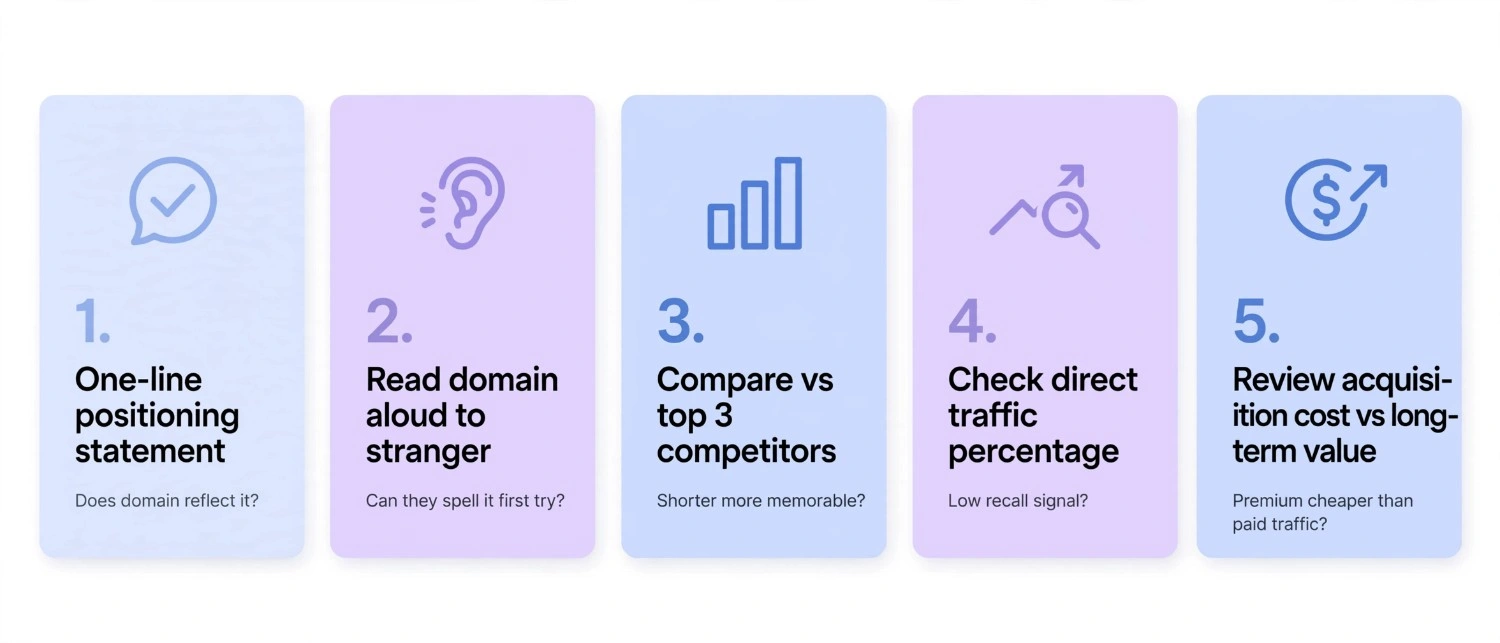
If you already own a domain and want to check whether it’s helping or hurting your brand, work through this quick audit:
- Write your brand’s one-line positioning statement. Does your domain reflect any part of it?
- Read your domain aloud to a stranger. Can they spell it back correctly on the first try?
- Compare it against your top three competitors’ domains. Is yours shorter, longer, more memorable, or less?
- Check your direct traffic percentage in analytics. Low direct traffic relative to industry norms can indicate weak domain recall.
- Review acquisition cost versus long-term value. A one-time premium domain purchase is often cheaper than years of paid traffic compensating for weak organic recall.
If your domain fails more than two of these checks, it may be actively limiting brand growth, and it’s worth evaluating an upgrade before the cost of switching grows alongside your business. The earlier this audit happens in a company’s lifecycle, the cheaper the fix, since a domain change becomes progressively more expensive to execute once it’s embedded in signage, legal contracts, paid ad history, and years of accumulated backlinks.
How Domain Valuation Ties Back to Brand Strength
Because a domain’s branding power is now a recognized part of its market value, professional appraisers weigh brandability alongside length, extension, and search volume when pricing premium names. Understanding how domain names are valued and the factors professional appraisers weigh can help you recognize why certain short, brandable names command significantly higher prices than purely descriptive alternatives.
This is also why timing and negotiation strategy matter so much when acquiring a premium name. If you’re closing in on a purchase decision, reviewing how to buy a premium domain name without overpaying will help you avoid common pricing traps during negotiation.
Domain Name Attributes and Their Brand Impact
| Domain Attribute | Brand Identity Impact | Recommended Action |
|---|---|---|
| Length | Shorter domains read as more established | Prioritize 6–10 character names where possible |
| Extension (.com vs alternatives) | .com remains the default trust signal | Choose .com for consumer-facing brands |
| Pronounceability | Drives word-of-mouth and recall | Test aloud before finalizing |
| Hyphens/numbers | Reduce perceived legitimacy | Avoid unless absolutely necessary |
| Keyword relevance | Aids category recognition | Use loosely, not forced |
| Brand-name match | Prevents customer confusion | Align domain with spoken brand name |
Domain Trust Signals in an AI-Driven Search Landscape
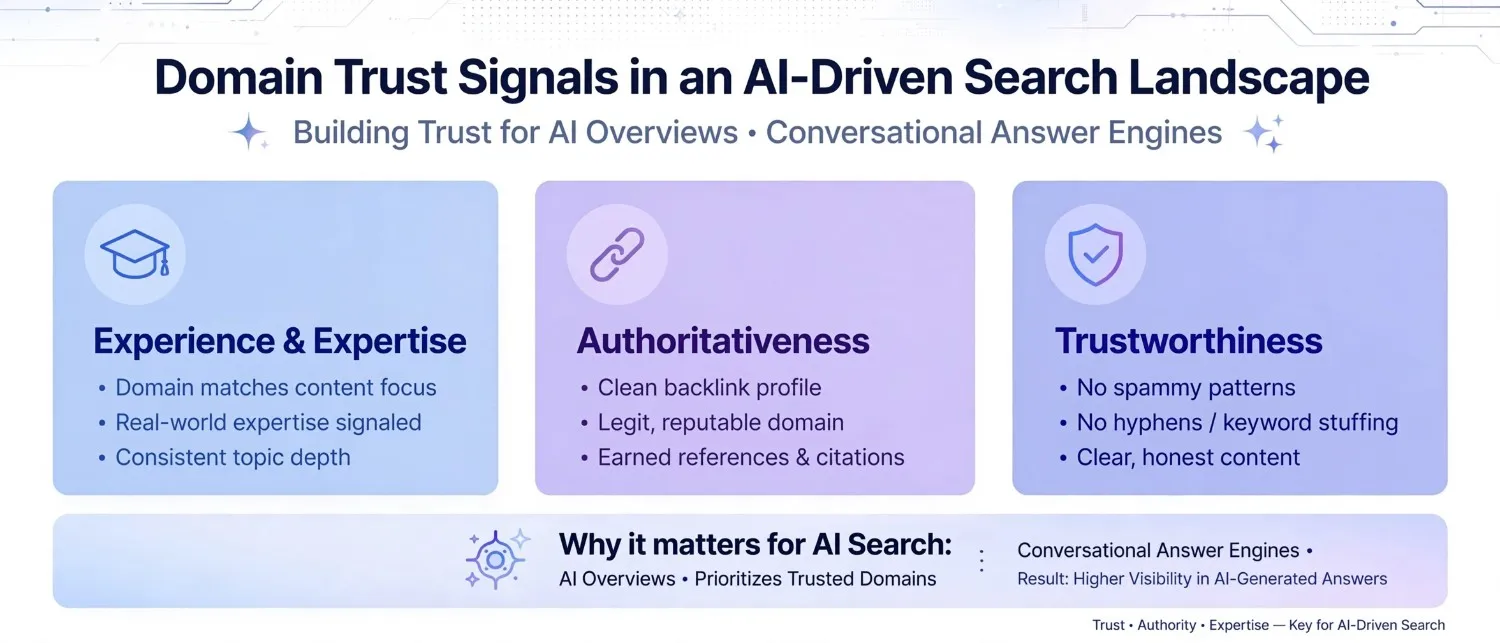
Search behavior has shifted meaningfully toward AI-generated overviews and conversational answer engines, and this shift raises the stakes on the domain name and brand identity connection rather than lowering them. When an AI overview summarizes a topic and cites a handful of sources, the visible domain becomes part of the trust equation for readers deciding whether to click through for more detail.
This ties directly into Google’s broader emphasis on Experience, Expertise, Authoritativeness, and Trustworthiness (E-E-A-T):
- Experience and Expertise: A domain that clearly matches its content focus helps both readers and algorithms understand what a site is authoritative about, reinforcing topical relevance signals.
- Authoritativeness: Established, well-matched domains tend to accumulate cleaner backlink profiles and citation patterns over time, since other publishers are more comfortable linking to a domain that looks legitimate.
- Trustworthiness: A domain free of spammy patterns (excessive hyphens, irrelevant keyword stuffing, expired-domain history) supports the broader trust signals search engines evaluate at the site level, not just the page level.
In practice, this means domain quality is no longer just a human perception issue, it increasingly intersects with how both algorithms and AI summarization tools model trust across a site’s entire footprint. Businesses investing in original, people-first content still need a domain that doesn’t undercut that investment before a single article is read.
When Does a Domain Upgrade Actually Make Sense?
Not every business needs to switch domains, and rebranding always carries some short-term risk. Still, a handful of signals suggest the conversation is worth having:
- You’re raising capital or preparing for acquisition, and investors have flagged the domain as a credibility gap during due diligence.
- Your current domain requires constant spelling clarification in sales calls, on the phone, or in verbal referrals.
- A competitor holds a noticeably stronger domain in the same category, and it’s visibly affecting comparison shopping.
- You’re expanding into a new market or vertical where the existing domain no longer accurately represents the business.
- Your brand has outgrown its founding-stage name, and the domain still reflects an earlier, narrower version of the company.
If two or more of these apply, it’s worth running the audit checklist above and weighing the one-time cost of a stronger domain against the ongoing cost of weaker recall and trust.
Frequently Asked Questions
What is the domain name and brand identity connection?
It’s the relationship between a website’s URL and how visitors perceive the business’s professionalism, trustworthiness, and category relevance, formed within seconds of seeing the domain, before any other content loads.
Does domain length really affect brand perception?
Yes. Shorter domains are consistently perceived as more established and professional, largely because they’re easier to recall, pronounce, and type correctly, while longer or hyphenated domains tend to signal a lower-budget or newer operation.
Should a domain always match the business name exactly?
Ideally yes. When the domain matches the spoken brand name, customers only need to remember one identifier instead of two, which reduces friction and improves direct traffic over time.
Is .com still the best extension for brand trust?
For most consumer-facing and transactional businesses, .com remains the strongest default trust signal, since it’s the extension audiences recognize and expect by habit.
Can a business rebrand its domain later without losing SEO value?
It’s possible with careful 301 redirects and a migration plan, but it involves some temporary risk to rankings and backlink equity, which is why choosing the right domain early is far more efficient than migrating later.
How much should a business invest in a premium domain name?
Investment should be weighed against the long-term cost of weak brand recall and lower direct traffic; many businesses find that a one-time premium domain purchase pays for itself faster than ongoing paid acquisition needed to compensate for a weak domain.
Treat Your Domain as a Core Brand Asset, Not an IT Decision
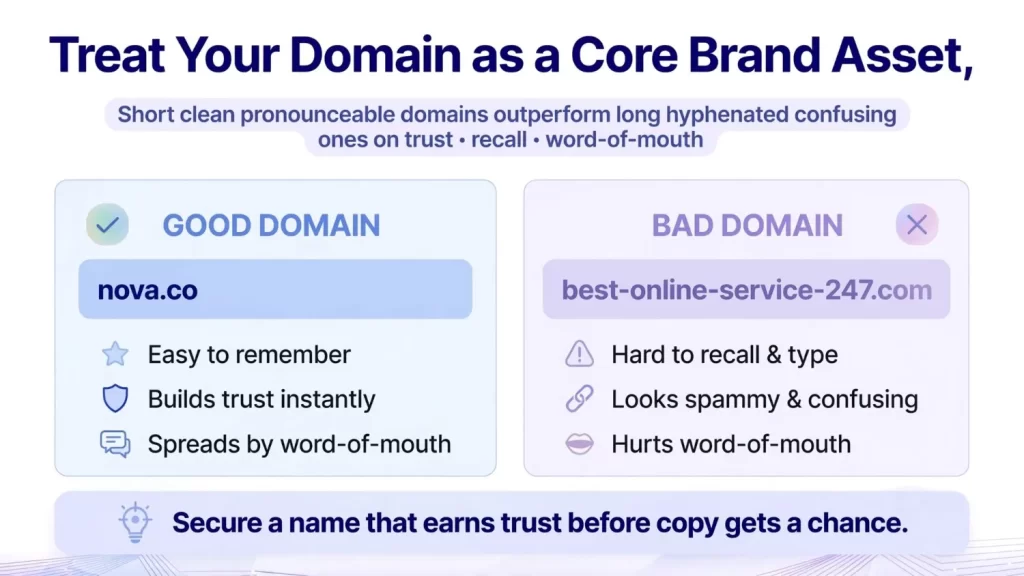
The domain name and brand identity connection isn’t a marketing theory, it’s a measurable first-impression effect that plays out every single time someone encounters your business online. Short, clean, pronounceable domains consistently outperform long, hyphenated, or confusing ones on trust, recall, and word-of-mouth growth. Founders who audit their domain with the same rigor they apply to logo design and messaging give every other marketing dollar a better chance of converting.
If your current domain is working against the brand you’re building, and secure a name that earns trust before your copy even gets a chance to.