
Domain names as digital real estate operate under a fixed-supply, infinite-demand model that physical property cannot replicate: there is exactly one version of every word, phrase, and brandable string in each top-level domain, and that scarcity compounds as global internet adoption grows. Unlike land, which can be rezoned, subdivided, or newly developed, a premium domain’s supply is permanently capped at the moment it is registered. This structural imbalance is why savvy investors increasingly treat domain acquisition with the same rigor as a real estate portfolio.


If you have ever compared buying a short, brandable domain to buying a plot of land in a growing city, you are not far off – but the analogy undersells the domain market in one critical way. Physical land has boundaries that can shift through annexation, rezoning laws that can be rewritten, and new construction that can add usable square footage to a market indefinitely. A six-letter .com, on the other hand, cannot be manufactured. There is a mathematically finite number of six-character combinations in the Latin alphabet, and once they are registered, no city council or governing body can vote a new one into existence. That single fact reshapes the entire investment calculus around domain names for sale, and it is worth unpacking in detail before you make your next acquisition.
What Makes Domain Names a Form of Digital Real Estate?
Domain names function as digital real estate because they occupy a unique, non-duplicable address on the internet – much like a physical lot occupies a unique address on a map. Just as no two properties can share the same street number, no two websites can share the same domain string. This is not a marketing metaphor; it is a technical reality baked into how DNS (Domain Name System) resolution works.

A domain name gives a business:
- A permanent digital location that customers can find, bookmark, and return to
- Brand equity that compounds over time, similar to how a storefront on a busy corner accrues foot-traffic value
- A transferable, sellable asset with its own resale market, comparable sales data, and appraisal methodology
Where the comparison gets interesting – and where domains start to pull ahead of physical property as an asset class – is in how each market handles supply.
The Core Difference: Fixed Digital Scarcity vs. Expandable Physical Supply
Physical real estate markets are elastic in ways most buyers underestimate. Municipalities regularly rezone agricultural land for residential development. Cities annex surrounding counties to expand their housing stock. Developers subdivide large lots into smaller units, effectively creating new “supply” out of existing land. None of these levers exist in the domain market.
Why Domain Supply Cannot Expand

Consider a specific, quantifiable example: six-letter, all-consonant .com domains. There is a hard mathematical ceiling on how many of these strings exist, and once the available inventory is registered, the only way to acquire one is through the aftermarket. This registration process itself is governed by ICANN, the global body responsible for coordinating domain name allocation, which is precisely why no new inventory can ever quietly appear. This is fundamentally different from, say, a housing market where a developer can respond to demand by building 500 new units next year.
For a deeper technical breakdown of this particular niche, see our guide on six-letter all-consonant domain names, which explains exactly how constrained that inventory really is.
Why Physical Property Supply Can Expand

Physical real estate supply responds to:
- Zoning changes that convert unused or agricultural land into buildable lots
- Vertical construction that adds housing units without adding land area
- Infrastructure investment (roads, utilities, transit) that opens previously inaccessible areas to development
- Policy incentives like density bonuses that increase how much can be built on existing parcels
Every one of these mechanisms gives physical markets a release valve that domains simply do not have. When demand for housing in a metro area spikes, supply can – eventually – catch up. When demand for short, memorable .com domains spikes, supply cannot catch up, because it was capped the moment ICANN opened .com registrations and the finite string-space was defined.
Comparison Table: Domain Names vs. Physical Real Estate Supply-Demand Dynamics
| Factor | Domain Names (Digital Real Estate) | Physical Real Estate |
|---|---|---|
| Supply ceiling | Fixed at registration; mathematically finite per TLD | Expandable via rezoning, construction, annexation |
| New inventory creation | Impossible for already-registered strings | Possible through development and subdivision |
| Maintenance costs | Annual renewal fee (typically $10-$50) | Property tax, insurance, upkeep, repairs |
| Market accessibility | Global buyer pool, 24/7 transactions | Often regional, subject to local regulation |
| Transfer speed | Minutes to days via registrar/escrow | Weeks to months via title transfer, closing |
| Depreciation risk | Minimal; brand relevance can fluctuate | Physical wear, market cycles, structural decay |
| Entry cost for premium assets | Ranges from hundreds to low millions | Typically requires six to eight figures minimum |
This table illustrates a point that is easy to state but genuinely important to internalize: the two asset classes share a scarcity-driven pricing logic, but only one of them has a supply side that is permanently locked. That is the crux of why domain names as digital real estate can, in certain segments, offer more favorable long-term dynamics than physical property.
How Demand Behaves Differently for Domains Compared to Property
Physical property demand is largely local. A house in one city does not compete directly with a house in another city for the same buyer, because most buyers are constrained by geography, employment, and lifestyle. Domain demand, by contrast, is global and instant. A startup in Singapore, a marketer in Berlin, and a founder in Austin can all be bidding on the same premium .com simultaneously, with no geographic friction whatsoever.

This global, frictionless demand pool has a few practical consequences:
- Price discovery happens faster because more eyes are on the same limited inventory at once
- Liquidity can spike unpredictably when a domain becomes relevant to a new industry trend (AI, crypto, biotech, etc.)
- Cross-border transactions are routine, whereas cross-border property purchases often involve legal complexity, currency risk, and residency restrictions
For context on how physical property demand behaves by comparison, research from the National Association of Realtors consistently shows housing demand clustering around regional job markets and local inventory levels – a stark contrast to the borderless bidding that defines domain acquisition.
If you want to understand how this plays out in practice, our breakdown of how the domain name aftermarket works walks through the mechanics of buyer discovery, private negotiation, and marketplace listings in more detail.
Sector-Specific Demand Spikes
One of the more interesting parallels to physical real estate is how demand clusters around emerging sectors, much like how a new transit line can spike demand for nearby housing. When a new technology category emerges, domains that fit that category’s naming conventions see immediate demand surges. This is especially visible with AI-related branding, where founders are racing to secure short, credible .com domains before their competitors do. We cover this pattern in depth in our domain name strategy for AI startups guide.
Why Scarcity Alone Doesn’t Guarantee Value: The Role of Brandability

Much like Google’s guidance on creating genuinely helpful, people-first content warns against surface-level value with no real substance, domain buyers should be wary of surface-level scarcity claims that ignore deeper brandability factors. It’s a common mistake to assume that scarcity alone drives domain value the way it drives land value. In reality, a domain also needs to be brandable, memorable, and pronounceable to command a premium. A random six-letter combination that is difficult to say aloud will not command the same price as one that reads like a real word or a plausible brand name – even though both are equally “scarce” in the mathematical sense.
This is where domain valuation diverges from a pure supply-and-demand model into something closer to appraisal-based real estate valuation, where location, condition, and “curb appeal” all factor in alongside scarcity. Our detailed guide on how domain names are valued breaks down the specific factors professional appraisers weigh, including length, extension, keyword relevance, and brandability score.
Common Mistakes Investors Make When Treating Domains Like Property

Even experienced real estate investors stumble when they first move into domain investing, because a handful of the underlying assumptions simply do not transfer. Some of the most frequent missteps include:
- Overpaying because a domain “feels” scarce without checking actual comparable sales data
- Ignoring brand identity fit and buying purely on length or keyword match
- Skipping due diligence on trademark conflicts, which can render an otherwise perfect domain legally unusable
- Underestimating the importance of WHOIS privacy and clean ownership history during a purchase
- Failing to negotiate through escrow, exposing both parties to fraud risk
- Treating every extension as equal, when in reality buyer trust and resale demand differ substantially between .com, .io, .co, and newer alternative extensions
Each of these mistakes tends to compound the others. A buyer who skips comparable-sales research, for instance, is also more likely to overlook a trademark conflict, simply because they are moving too quickly to complete diligence properly. Slowing down at the research stage – exactly as a careful property buyer would before signing an offer – remains the single best safeguard against a costly misstep.
On that last point, understanding ownership transparency matters more than most first-time buyers realize. Our resource on domain name WHOIS privacy explains what buyers should verify before wiring funds for a premium acquisition.
Expert Tips: How to Evaluate a Domain the Way You’d Evaluate Real Estate

Treating a domain purchase with real estate-level diligence tends to produce far better long-term outcomes. Here is a practical framework:
- Check “zoning” fit first: does the domain’s extension (.com, .io, .co) match the industry norms your buyers expect?
- Assess “curb appeal”: is the domain easy to say over the phone, spell from memory, and type without typos?
- Verify “title” cleanliness: run a trademark search and confirm the seller has clear, transferable ownership
- Compare “comps”: look at recent sales of similarly structured domains before making an offer
- Negotiate through a licensed escrow service, the domain-world equivalent of a title company
For a step-by-step walkthrough of the negotiation and closing process, see our guide on how to buy a premium domain name without overpaying.
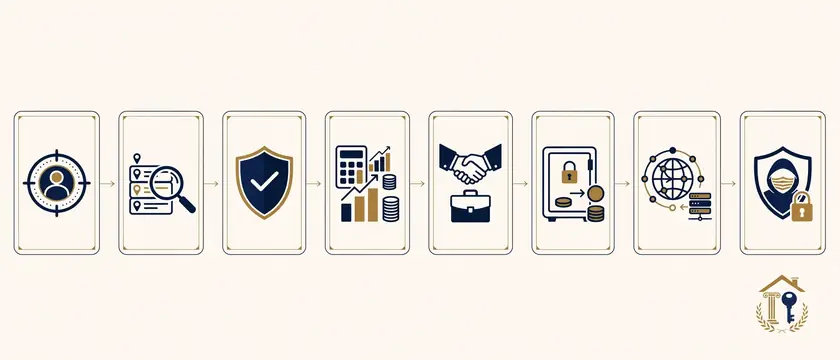
Step-by-Step: Acquiring a Premium Domain as a Digital Real Estate Investment
- Define your target profile – length, extension, keyword relevance, and industry fit
- Search active listings and aftermarket inventory across reputable marketplaces
- Verify ownership and trademark status before making contact
- Request or calculate a comparable-sales-based valuation
- Open negotiations, ideally through a broker or direct outreach
- Use a licensed escrow service to handle payment and transfer
- Confirm DNS and registrar transfer completion before releasing final payment
- Register the asset under WHOIS privacy protection once transfer is complete
This process mirrors a real estate closing almost step for step, right down to the use of a neutral third party (escrow) to protect both sides of the transaction.
Why Length and Extension Function Like “Lot Size” and “Location”
In physical real estate, two of the biggest price drivers are lot size and location. In domain real estate, the equivalent variables are character length and top-level extension (TLD). Shorter domains are the equivalent of larger, more central lots – there are simply fewer of them, and demand for the ones that exist is intense. The extension functions like the neighborhood: a .com is the downtown core, while newer extensions are still-developing suburbs with lower baseline demand but sometimes better relative value.
Our article on why domain name length matters for brand success goes deeper into how length specifically correlates with brand recall, typing accuracy, and long-term resale value.
How Domain Ownership Shapes Brand Identity – Another Parallel to Property
Just as a business’s physical address can shape how customers perceive it (a Fifth Avenue storefront signals something different than a strip-mall unit), a domain name shapes digital brand perception before a visitor even loads the homepage. A short, clean .com signals legitimacy and staying power. A long, hyphenated, or oddly-extended domain can quietly undermine trust, even if the underlying product is excellent.
We explore this relationship in detail in how your domain name shapes brand identity, which is worth reading alongside this piece if you are actively shopping for a domain to anchor a new brand.
Liquidity: How Quickly Can You Actually Sell?
Liquidity is one of the most misunderstood variables when investors compare domains to physical property, and it cuts in interesting directions for both asset classes. Physical real estate transactions typically take 30 to 90 days to close, even in a hot market, because they involve inspections, financing approval, title searches, and often multiple layers of legal review. Domain transactions, by contrast, can close within hours once both parties agree on price, largely because there is no physical inspection required and no mortgage underwriting to wait on.

That said, liquidity in the domain market is not uniform. A short, dictionary-word .com will typically attract multiple interested buyers within days of being listed. A longer, more niche domain might sit for months without a serious offer. This mirrors the physical property market almost exactly: a well-located single-family home in a desirable school district sells faster than a rural parcel with limited access, even though both are technically “real estate.”
For investors building a portfolio, this means diversifying across:
- Ultra-premium short domains that are highly liquid but carry a higher entry price
- Mid-tier brandable domains that balance affordability with reasonable resale speed
- Niche, keyword-specific domains that may take longer to sell but can command outsized returns when the right buyer appears
Why Escrow Speeds Up Domain Liquidity
Because domain transfers can be verified and completed digitally, licensed escrow providers can confirm both payment and DNS transfer within the same business day in many cases. This is a structural advantage that physical property simply cannot match, since deed recording and title transfer require government processing timelines that vary by jurisdiction and can stretch into weeks.
Historical Price Trends: What the Data Shows
Domain valuation data over the past two decades shows a consistent pattern: short, brandable, keyword-relevant .com domains have appreciated steadily, particularly in categories tied to emerging technology sectors. While individual sales vary widely – and past performance is never a guarantee of future results – the broader trend lines up with the core thesis of this article: fixed supply plus rising global demand tends to push prices upward over time, absent some external shock to demand itself.
Physical real estate has historically shown similar long-term appreciation, but with far more regional variability. A property in a declining industrial town can lose value for decades, while a property in a growing metro area can outperform national averages significantly. Domains are less tied to geography, which smooths out some of this regional volatility, but they introduce their own variable: relevance to shifting digital trends. A domain tied to a fading technology category can lose demand even as the overall domain market grows, just as a property tied to a fading industry can lose value even as the national housing market grows.
Tax and Legal Considerations for Domain Investors

Domain ownership carries a lighter regulatory footprint than physical property in most jurisdictions, but it is not entirely without complexity. Investors should be aware of a few recurring considerations:
- Capital gains treatment: in many jurisdictions, profit from domain resale is treated similarly to the sale of other intangible assets, though rules vary by country and investors should consult a qualified tax professional
- Trademark exposure: purchasing a domain that infringes on an existing trademark can result in a UDRP (Uniform Domain-Name Dispute-Resolution Policy) complaint, which can strip ownership even after a legitimate purchase
- Registrar-level compliance: unlike a property deed, domain ownership is mediated entirely through a registrar and the underlying registry, meaning account security (two-factor authentication, registrar locks) plays a much larger role in asset protection than most new investors expect
- No local zoning restrictions: because domains are not tied to physical jurisdictions, investors do not face the kind of local zoning battles, permit denials, or land-use disputes that can stall a physical real estate project for years
Compared to the legal complexity of a property closing – title insurance, easement research, survey verification – domain transactions are comparatively streamlined. The main due-diligence burden shifts from physical inspection to intellectual property and ownership-history verification.
Building a Diversified Digital Real Estate Portfolio
Just as sophisticated property investors diversify across residential, commercial, and industrial assets to manage risk, domain investors benefit from diversifying across length, extension, and industry category. A portfolio concentrated entirely in one narrow keyword niche is exposed to the same risk as a property portfolio concentrated in a single declining town: if demand for that niche cools, the entire portfolio’s value can soften simultaneously.
A more resilient approach typically includes:
- A core holding of short, brandable .com domains with broad appeal across industries
- A smaller allocation to emerging-category domains tied to sectors like AI, clean energy, or fintech
- A handful of geographically or linguistically targeted domains for investors with cross-border ambitions
- Ongoing monitoring of expiring domains and aftermarket listings to opportunistically add inventory at fair prices
This approach treats the domain portfolio the same way a real estate investment trust treats its property holdings: not as a single bet, but as a basket of assets designed to perform across a range of market conditions.
Quick Answer: Is Domain Investing Riskier Than Real Estate Investing?

Domain investing carries different risk factors than real estate, not necessarily more of them. Property investors face market cycles, interest rate exposure, and maintenance liability. Domain investors face brand-relevance risk and liquidity variability, but benefit from dramatically lower carrying costs (often under $50/year versus thousands in property tax and upkeep) and a truly global buyer pool. For patient investors focused on short, brandable assets, the risk-adjusted case for domain names as digital real estate has strengthened considerably over the past decade as more of commerce and brand-building has moved online.
Frequently Asked Questions
What does it mean to call domain names digital real estate?
It means domain names function like unique, ownable digital addresses – scarce, transferable, and appreciating assets – in much the same way a physical property occupies one fixed, unrepeatable location.
Why are domain names as digital real estate considered a better supply-demand model than physical property?
Because domain supply is mathematically fixed at registration and can never expand, whereas physical property supply can grow through rezoning, construction, and annexation.
Do domain names appreciate in value like real estate?
Premium, brandable domains – particularly short .com names – have historically appreciated as global internet adoption and brand competition have increased, though individual outcomes vary based on length, extension, and market timing.
What is the biggest cost advantage domains have over physical property?
Annual renewal fees for domains are typically a fraction of what property owners pay in taxes, insurance, and maintenance combined, which meaningfully improves the long-term holding economics.
How do I know if a domain is a good investment?
Evaluate it the way you would evaluate a property: check length, extension fit, brandability, trademark cleanliness, and comparable recent sales before making an offer.
Can domain supply ever increase the way housing supply does?
Only in a very limited sense – new top-level extensions can be introduced, effectively creating a new “neighborhood,” but the supply of a specific string within an already-established extension like .com is permanently fixed once every combination is registered.
Is it better to hold one premium domain or diversify across several smaller ones?
Most experienced investors favor diversification across length, extension, and industry category, since concentrating in a single narrow niche exposes the portfolio to the same risk a real estate portfolio faces when it’s overweight in one declining region.
Conclusion: Building a Smarter Digital Real Estate Portfolio

The parallels between domain names and physical property go far beyond marketing language. Both are scarce, both are location-defined, and both reward buyers who do their diligence before closing a deal. Where domains pull ahead is in the one variable that matters most to long-term investors: supply can never expand to meet rising demand. That structural advantage, paired with dramatically lower carrying costs and a truly global buyer pool, is why domain names as digital real estate deserve a place in any serious digital asset strategy.
For investors who have spent years evaluating physical property, the transition to domain investing tends to feel less like learning an entirely new discipline and more like applying a familiar playbook to a market with better fundamentals: no property tax, no maintenance calls, no tenant disputes, and a supply curve that genuinely cannot bend under pressure. That combination is difficult to find anywhere else in the asset world, digital or physical.
If you’re ready to start building your portfolio with names that fit this exact profile, explore our current inventory of 6 letter domain names for sale and see which short, brandable assets are still available before the remaining supply disappears.